Saturday, April 30, 2011

Honey Bees (Apis Mellifera)

The weather is wonderful, and for the first time in about eight years it is coinciding with an abundance of blossom from which ours bees can get ample supplies of nectar and pollen. So far it has been a great year for bees, acres of dandelions which yields nectar at low temperatures and plenty of pollen from Pussy Willow etc gave them a great chance to build up numbers over the last month or so and now the hives are bursting with bees and they are taking full advantage of the opportunity, and so am I!
The Horse Chestnuts and Sycamores are both in flower...
 ..as is this tree in the orchard, an ideas as to what it is?
It's a Quince and sorry to go all flowery again but they really are spectacular.
Our native apples are also in flower.....
...and indeed this Ecklinville Seedling is only just about to start.
The only real way to tell what blossom the bees are working if you don't actually see them on it, is by the colour of the pollen, and in this case it looks like Sycamore. There is also brick red pollen going in which  means they are also working Chestnut.
As you can see there are lots of bees in this hive, and these are probably only the house bees since the photo was taken on a warm sunny day (yesterday) and all the flying bees are out foraging.
You may notice a drawing pin on a frame on the LHS of the photo. There is also one that you can't see on the RHS, these mark the extent of the brood nest at the last inspection and in this hive there are 15 sides of brood which means that the colony is building up really well and could do with more room. It's time for a 'super' and we'll hopefully get some honey.

'Supers' on and fingers crossed for some honey. The whitethorn is about to flower so if the weather holds we should get a good crop.
The tall hive on the left is the strongest, and has already supplied 2 frames of capped brood to the colony on the right which was wintered as a 'Nuc', thereby allowing it to build up more quickly. Not only that but it has a second brood box on because I wanted to get some frames drawn, and they have drawn 5 frames in 4 days. Busy Bees!


We are members of the Midland Beekeepers Association  whose help and training has been invaluable. If you are interested in beekeeping it's important to find a local association for help and advice particular to your area.

Saturday, April 16, 2011

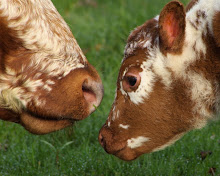
Moile Calves

Two Moile cows were due to calve this spring.
The first to calve, last Saturday, was Derrynagarra Hilda, a lovely heifer bred by us. It was her first calf which is always an anxious time for everyone, but her mothering instincts are very strong and she had her calf licked dry and suckling in no time.
Derrynagarra Doreen
She is a beautiful heifer calf 1 day old in this photo, with Mum keeping a very close eye!

Two days later, Derrynagarra Gwen calved and had a nice bull calf. This is her third calf and so she is an old hand at this now and is an excellent mother.
He is only 20 minutes old in this photo. We haven't named him yet!
Any ideas?

All calves must be tagged and registered with the Dept of Agriculture within 20 days of birth. The Dept keeps very detailed individual records of all animals in the National Herd, and from the tag number can tell age, date of birth, breed, where it was born, where it is now, owners details, all movements, tag number of dam etc etc.
From a farmers herd number they can tell how many animals are in the herd and all their details, and from this they can calculate the amounts of nitrates and phosphates produced!
So, there is no option they have to be tagged and the longer I put it off the stronger the calf gets and the more difficult it becomes.

With the mothers safely restrained in the crush, the calves get an individual tag in each ear.

Fast asleep in the sunshine later the same day, none the worse for ware!

Both calves about a week old!

Saturday, April 9, 2011

An Taisce National Spring Clean

We tend to take the litter on the sides of our roads for granted, but in reality it is a national disgrace. Running a Bed & Breakfast as we do, it is only when you drive with the eyes of a tourist that you see how bad it really is, and so spurred on by An Taisce's National Spring Clean initiative, Helen organised to clean the verges of our local road (L5738), a distance of about 3 miles starting at 10 o'clock this morning.
 An Taisce provided us with a Kit containing gloves, colour coded bags, green for general waste, yellow for plastic and blue for cans, as well as plastic vests telling people what we were up to. They also provided information on what to do with all the rubbish, and it looks like Westmeath County Council will come and take it away!
 It took three of us about 2 hours to clean from one end to the other!
The clean up crew! All this from just 3 miles.
The National Spring Clean runs from 1st to 30th April. Good luck to everyone involved!

Monday, April 4, 2011

Spring Photos

Ok, ok, I admit the whole job's going a bit flowery but it is Spring and I'm allowed! Anyway, a few late nights lambing and I should be back to normal!
Bull Rush seed head, an interesting shape!
 Pussy Willow. This one was full of bumble bees making a tremendous racket as they went about their work. Our honey bees are also on pussy willow although I didn't see any in this tree, but there is lots of bright yellow pollen going into the hives.


The damsons in the orchard are also in flower!
Despise ye not the humble dandelion for it is a very important plant for bees. There is lots of pollen this time of year, but very little nectar available to honey bees, and dandelions provide the first significant source of the season and equally importantly, they yield up their nectar at low temperatures!
Our whitethorn hedge, planted 2 years ago and doing well, plus one of my favourite tree the Scots Pine, not yet magnificent but it will be some day. Interesting thing about whitethorn is that it flowers on last years growth, so if you clip it every year it can't flower!

Friday, March 25, 2011

"I know a bank where the wild thyme blows"

Spring is well and truly here, the birds are all singing, the snowdrops are over, the daffodils are out and all the wildflowers are starting to bloom.

Primroses are in bloom along the lane and all around the banks of the farm.


The first of the violets are also starting to flower.


Perhaps somewhat surprisingly the wild strawberries are also in flower.


A magical time of year even without Oberon and Titania.

Saturday, March 12, 2011

Fencing - Stage 2

Another gloriously sunny day, absolutely ideal and so back to the fence. I need to get it finished so the sheep can go back into this field during lambing which is only about 3 weeks away!
The next job is to make an 'H' frame at either end of the fence to support the strainer and stop it leaning over when the tension of the fencing wire comes on it. And it's going to be under quite a lot of tension as you will see later.
Having secured it at one end, the sheep wire is then rolled out along the fence....
.....and attached to the tractor using my homemade sheep wire puller.
I asked a man once how tight the sheep wire should be pulled: "Well", he said "I have a Massey 165 and I just pull until the front wheels come off the ground and put on the handbrake. That's usually about  right!" (Health Warning: do not try this at home!) 
That's the sheep wire up, and the hedge is now safe! I'll put an electric top strand on later to stop the cattle and horses from leaning over and having a gentle nibble, but that's for another day!
Close-up of sheep wire strainer as requested by farmersimonk

Sunday, March 6, 2011

Fencing - Stage 1

Having planted our new hedge we have to put up a new fence to keep the stock away from it. There is nothing sheep like more than a nice tender, green shoot of new hedge even if they're up to their oxters in grass!
The quad is one of the most versatile machines we have, and having loaded the trailer, I drove along and put out the posts in the line of the new fence.
 We have a tractor-mounted fence post driver, which makes very short work of putting in posts.
With a 7' straining post driven down to about 4' at either end of the fence, I run a line of wire between them and having pulled it tight, I have a straight line to follow when hammering in the intermediates.
Within reason, it doesn't matter what angle the tractor is at because you can adjust the post driver to suit.
Nearly all in!
Included this because I quite like the photo. It also gives an idea of how the machine works, and when you consider that the hammer weighs 380kg it's not surprising that it will drive even the biggest posts with ease!
Related Posts Plugin for WordPress, Blogger...